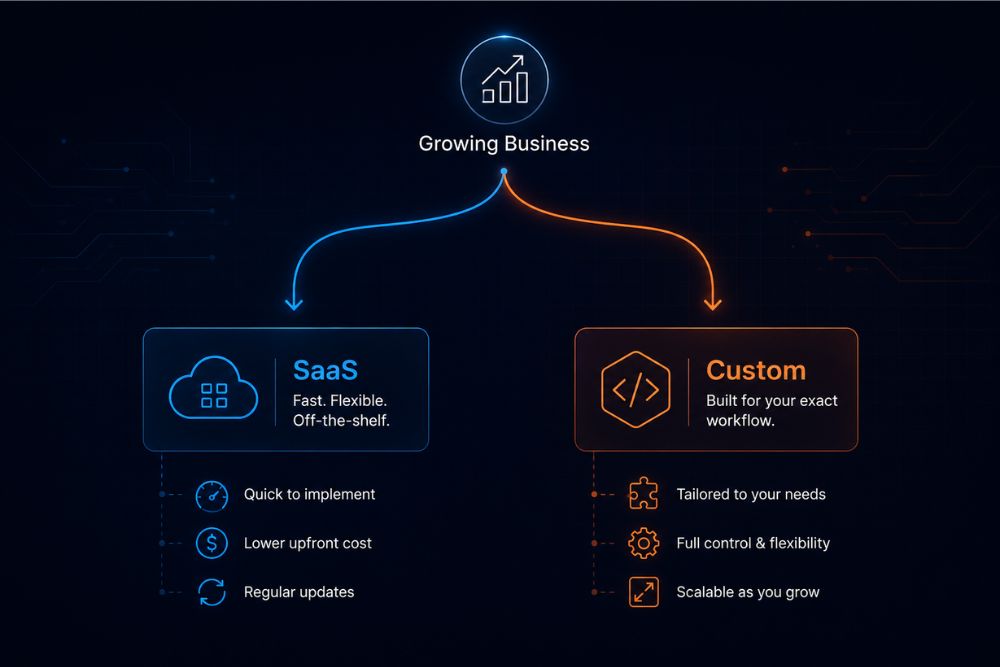
Custom Software vs SaaS: What Should a Growing Business Choose?
If you're comparing custom software vs SaaS for your business, you've probably already outgrown the "just Google a tool for it" phase. That's usually the moment this question starts mattering — not at day one, but somewhere around the point where your processes stop fitting neatly into someone else's template.
This guide breaks down the real differences, the honest trade-offs, and how to know which one is right for where your business actually is — not where a sales pitch wants you to be.
What's the Difference Between SaaS and Custom Software?
SaaS (Software-as-a-Service) is a subscription-based tool built to serve many businesses at once — think Odoo, ERPNext, Salesforce, or QuickBooks. You pay monthly, it's ready to use immediately, and updates happen automatically.
Custom software is built specifically for your business — your workflows, your data structure, your rules. You (or a development partner) own it outright, and it's built to fit exactly how your team already works, not the other way around.
Neither is "better" in the abstract. The right choice depends entirely on your stage, your workflow complexity, and your growth trajectory.
SaaS: When It's the Right Choice
SaaS tools exist for a good reason — for most businesses, most of the time, they're the smarter starting point.
Choose SaaS when:
- You're early-stage and still discovering your exact workflow needs
- Your processes are fairly standard (invoicing, basic CRM, project tracking)
- You need to be live in days, not months
- Budget for upfront development isn't there yet
- You don't yet have the in-house or partner expertise to maintain custom code
The real cost of SaaS isn't just the subscription fee — it's the compounding cost of workarounds. A tool that's "80% right" for your business means your team spends time every week manually patching that missing 20%: exporting to Excel, re-entering data across systems, or keeping a side spreadsheet the software should have handled.
Custom Software: When It's Worth the Investment
Choose custom software when:
- Your workflow has genuine industry-specific complexity a generic tool can't flex to (batch tracking, compliance rules, unique pricing logic)
- You're paying for multiple tools that don't talk to each other, and integration costs are climbing
- Your team has built manual workarounds that are now a bigger time cost than a custom build would be
- You need the software to be a competitive advantage, not just a back-office utility
- You've outgrown SaaS tiers and keep hitting per-user or per-feature pricing walls
A useful gut-check: if your team already has a workaround for a workaround, that's usually the sign. When "how do we track this in the system" reliably ends in "oh, we just do that part in WhatsApp/Excel," the software has stopped fitting the business.
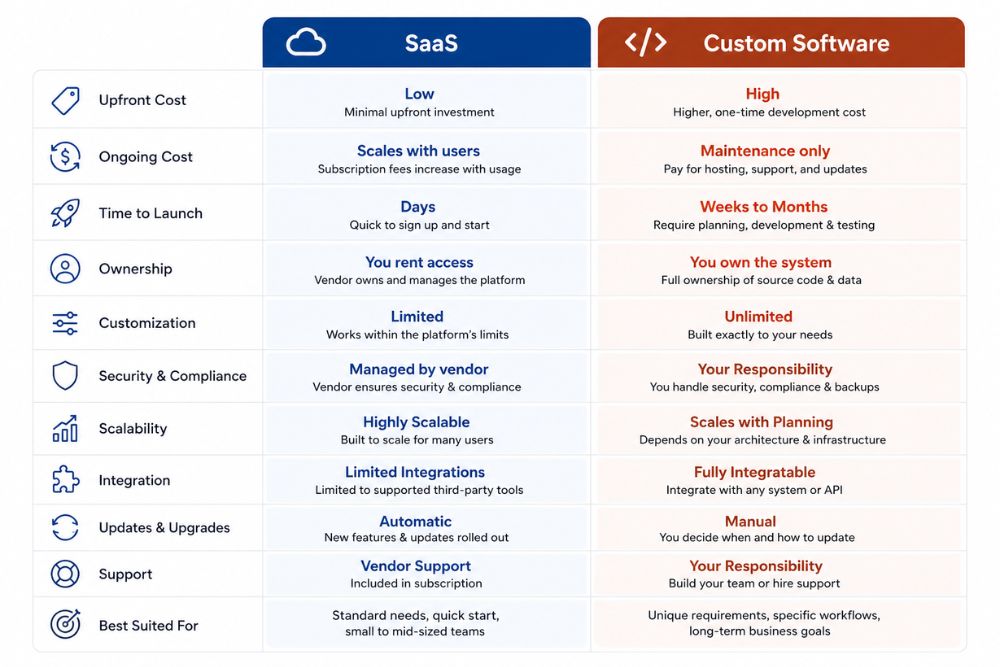
Custom Software vs SaaS: Cost Comparison
| Factor | SaaS | Custom Software |
| Upfront cost | Low | Higher (one-time build cost) |
| Ongoing cost | Recurring subscription, scales with users/features | Maintenance only, no per-seat fees |
| Time to launch | Days | Weeks to months |
| Fit to your workflow | Generic, some workarounds needed | Built to your exact process |
| Ownership | You rent access | You own the system |
| Scalability | Limited by the vendor's roadmap | Scales exactly as your business does |
The break-even point varies, but as a rule of thumb: if your SaaS workaround costs (in time, errors, or lost efficiency) are exceeding what a custom build would cost within 18-24 months, custom is usually the financially smarter move.
Real Example: When Off-the-Shelf ERP Stops Working
We've seen this pattern repeat across industries. A gold manufacturing business running Odoo, and a logistics company running ERPNext, both hit the same wall — both platforms got them off spreadsheets and into structured systems, which mattered early on. But neither platform was built for the specifics of their operations: batch traceability and purity-based pricing logic for the manufacturer, and fleet/routing compliance workflows for the logistics company.
In both cases, the decision to move to custom software wasn't about the SaaS tool being "bad" — it was about the business outgrowing what a generic template could flex to.
How to Decide: A Simple Framework
Ask these questions before deciding:
- Is the problem a process problem or a software problem? No system fixes a workflow issue like three people re-approving the same invoice because of internal trust gaps.
- How much are your current workarounds actually costing? Add up the hours per week your team spends patching gaps — that's your real comparison number, not just the subscription price.
- Is your workflow genuinely unique, or just "not yet configured"? Sometimes a SaaS tool can be configured further before concluding it can't fit.
- Do you have (or can you get) a development partner who understands your industry? Custom software is only a good investment if it's built and maintained properly.
The Honest Answer
Most growing businesses should start on SaaS and graduate to custom only when the workarounds start costing more than a build would. Custom software isn't a status symbol — it's a decision that should be driven by the math, not by what sounds impressive.
If you're at the point where your team has more workarounds than workflows, it's worth a conversation — even if the answer turns out to be "you're not there yet."
CRUDOPS builds custom software, ERP systems, and business applications for growing companies across manufacturing, logistics, and other operations-heavy industries. If you're weighing custom software vs SaaS for your business, [get in touch] for a no-pressure assessment of what actually fits your stage.

Join the Discussion
Share your detailed thoughts or questions below.